Pacific jack mackerel + Striped mullet
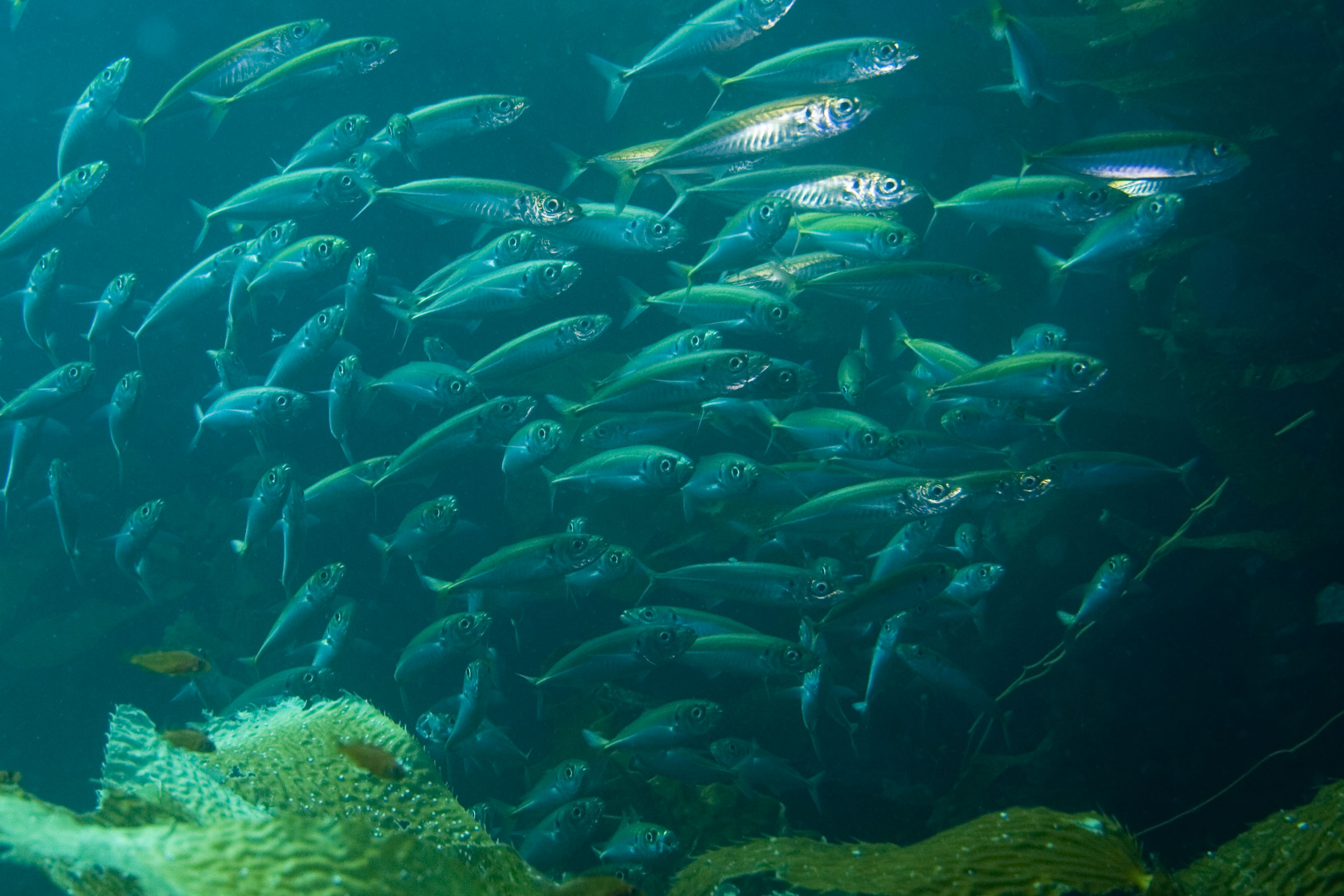
The Pacific jack mackerel,Trachurus symmetricus (also known as the Californian jack mackerel or simply jack mackerel), is an abundant species of pelagic marine fish in the jack family, Carangidae. The species is distributed along the western coast of North America, ranging from Alaska in the north to the Gulf of California in the south, inhabiting both offshore and inshore environments. The Pacific jack mackerel is a moderately large fish, growing to a maximum recorded length of 81 cm, although commonly seen below 55 cm. It is very similar in appearance to other members of its genus, Trachurus, especially Trachurus murphyi, which was once thought to be a subspecies of T. symmetricus, and inhabits waters further south. Pacific jack mackerel travel in large schools, ranging up to 600 miles offshore and to depths of 400 m, generally moving through the upper part of the water column.

The flathead mullet, Mugil cephalus, is a mullet of the genus Mugil in the family Mugilidae, found in coastal tropical and subtropical waters worldwide. Its length is typically 30 to 75 centimetres (to in). This species occurs worldwide, attested by other common names for this fish: Black mullet - Cuba, US Bully mullet - Australia, Vietnam Callifaver mullet - Cuba, Netherlands Antilles, US Common grey mullet - UK Common mullet - Cuba, Netherlands Antilles, US Flathead grey mullet - India, Philippines (where it's known as either aligasid or talilong), UK Flathead mullet - Europe, FAO, UN, Fishbase Grey mullet - Turkey, Australia, Taiwan, Cuba, Fiji, Hong Kong, Mauritius, Netherlands Antilles, New Zealand, Spain, Tonga, UK, US, Mediterranean, Egypt Hardgut mullet - Australia Mangrove mullet - Australia Sea mullet - Australia, Fiji, Papua New Guinea, UK Striped mullet - Australia, Cuba, Mexico, UK, US. The Striped Mullet is a mainly diurnal coastal species that often enters estuaries and rivers. The Striped Mullet usually schools over sand or mud bottoms, feeding on zooplankton. The Adult fish normally feed on algae in fresh water. The maximum size the Striped Mullet may reach is approximately 120 cm, with a max weight of about 8,000 g. The species is euryhaline meaning that the fish can acclimate to different levels of salinity; this combined with the acclimation of juveniles to high water temperatures appears to be a selective advantage.
Shared flavor compounds
These compounds appear in both Pacific jack mackerel and Striped mullet, giving them a molecular basis for flavor affinity, the pairing principle articulated by Francois Benzi and implemented in flavor-pairing research.
Why it works
The flavor-pairing hypothesis proposes that ingredients sharing significant aromatic compounds harmonize on the palate. Pacific jack mackerel and Striped mullet overlap on 17 key compound(s), which is why classic culinary traditions, and our deterministic matching algorithm, place them together.
- Pairing computed by: pairing-compute
- Methodology: deterministic compound-overlap matching (no LLM)
- Compound data: Wikidata + Wikidata
- Part of: Living Gastronomic Intelligence graph