Ocean pout + Enchilada

The ocean pout (Zoarces americanus) is an eelpout in the family Zoarcidae. It is found in the Northwest Atlantic Ocean, off the coast of New England and eastern Canada. The fish has antifreeze proteins in its blood, giving it the ability to survive in near-freezing waters. Scientists have done studies wherein genes are taken from the ocean pout and implanted into salmon in an attempt to make the latter grow faster. These genes transfer the ocean pout's tolerance for extremely cold waters to the salmon, allowing it to grow year-round. The promoter for the antifreeze protein gene is also used in conjunction with the growth hormone taken from a chinook salmon, which leads to a higher concentration of the growth hormone in the blood; causing the genetically modified salmon to grow much more rapidly than it would naturally. Controversy has arisen, as some view the altered fish as a potential threat to wild salmon stocks if it escapes or is ever released into the wild. Chefs and grocers in numerous US states have agreed not to sell the new fish over these concerns, citing concerns over its safety for human consumption. In June 2006 the Unilever company announced that it would use genetically modified yeast to grow antifreeze proteins based on a gene from the ocean pout, and use it to improve the consistency and storage properties of its ice cream brands.
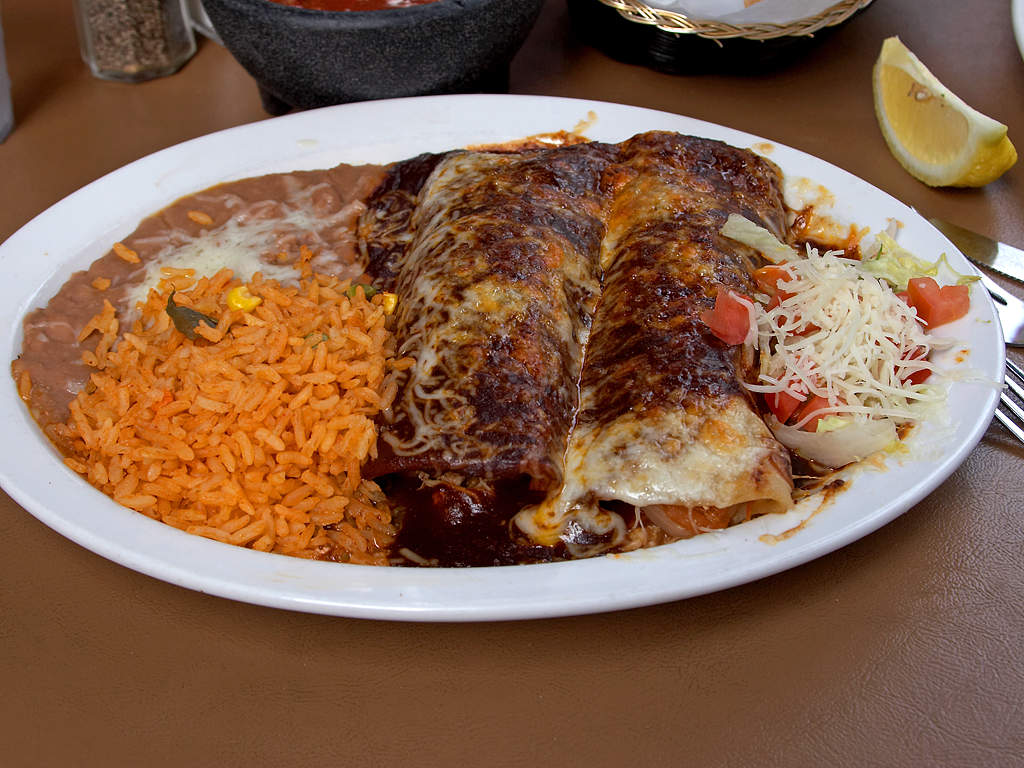
Corn tortilla rolled around a filling and covered with a sauce
Shared flavor compounds
These compounds appear in both Ocean pout and Enchilada, giving them a molecular basis for flavor affinity, the pairing principle articulated by Francois Benzi and implemented in flavor-pairing research.
Why it works
The flavor-pairing hypothesis proposes that ingredients sharing significant aromatic compounds harmonize on the palate. Ocean pout and Enchilada overlap on 18 key compound(s), which is why classic culinary traditions, and our deterministic matching algorithm, place them together.
- Pairing computed by: pairing-compute
- Methodology: deterministic compound-overlap matching (no LLM)
- Compound data: Wikidata + Wikidata
- Part of: Living Gastronomic Intelligence graph