Towel gourd + Yardlong bean
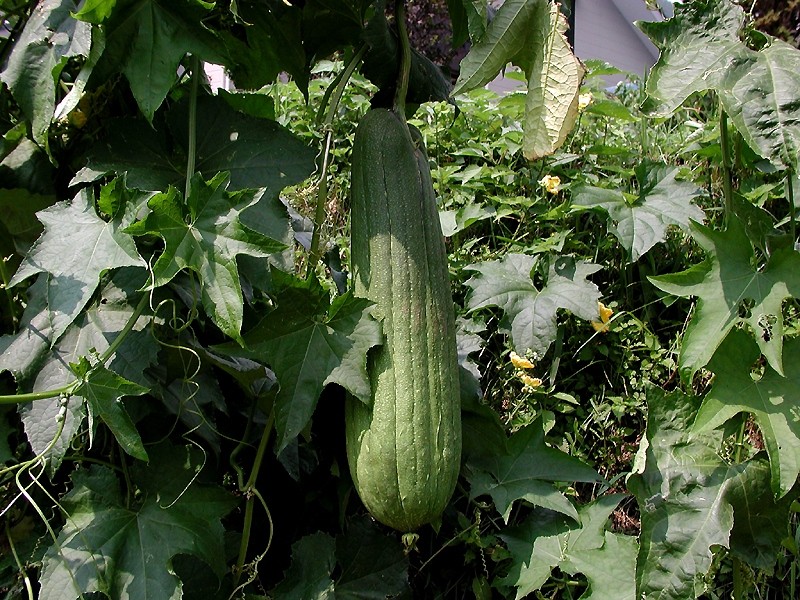
Luffa is a genus of tropical and subtropical vines classified in the cucumber family. In everyday non-technical usage the name, also spelled loofah, usually refers to the fruit of the two species Luffa aegyptiaca and Luffa acutangula. The fruit of these species is cultivated and eaten as a vegetable. The fruit must be harvested at a young stage of development to be edible. The vegetable is popular in China and southeast Asia. When the fruit is fully ripened it is very fibrous. The fully developed fruit is the source of the loofah scrubbing sponge which is used in bathrooms and kitchens as a sponge tool. Luffa are not frost-hardy, and require 150 to 200 warm days to mature.
Vigna unguiculata subsp. sesquipedalis is a legume cultivated to be eaten as green pods. It is known as the yardlong bean, bora, long-podded cowpea, asparagus bean, snake bean, or Chinese long bean. Despite common name, the pods are actually only about half a yard long; the subspecies name sesquipedalis (one-and-a-half-foot-long) is a rather exact approximation of the pods' length. This plant is of a different genus than the common bean. It is a vigorous climbing annual vine. The plant is subtropical/tropical and most widely grown in the warmer parts of South Asia, Southeast Asia, and southern China. A variety of the cowpea, it is grown primarily for its strikingly long (35-75 cm) immature pods and has uses very similar to that of the green bean. The many varieties of yardlong beans are usually distinguished by the different colors of their mature seeds. The pods, which can begin to form just 60 days after sowing, hang in groups of two or more. They are best for vegetable use if picked before they reach full maturity; however, overlooked pods can be used like dry beans in soups. When harvesting, it is important not to pick the buds which are above the beans; since the plant will set many more beans on the same stem. The plants take longer to reach maturity than bush beans, but once producing, the beans are quick-growing and daily checking/harvesting is often a necessity. The plants will produce beans until frost.
Shared flavor compounds
These compounds appear in both Towel gourd and Yardlong bean, giving them a molecular basis for flavor affinity, the pairing principle articulated by Francois Benzi and implemented in flavor-pairing research.
Why it works
The flavor-pairing hypothesis proposes that ingredients sharing significant aromatic compounds harmonize on the palate. Towel gourd and Yardlong bean overlap on 20 key compound(s), which is why classic culinary traditions, and our deterministic matching algorithm, place them together.
- Pairing computed by: pairing-compute
- Methodology: deterministic compound-overlap matching (no LLM)
- Compound data: Wikidata + Wikidata
- Part of: Living Gastronomic Intelligence graph