Phyllo dough + Succotash
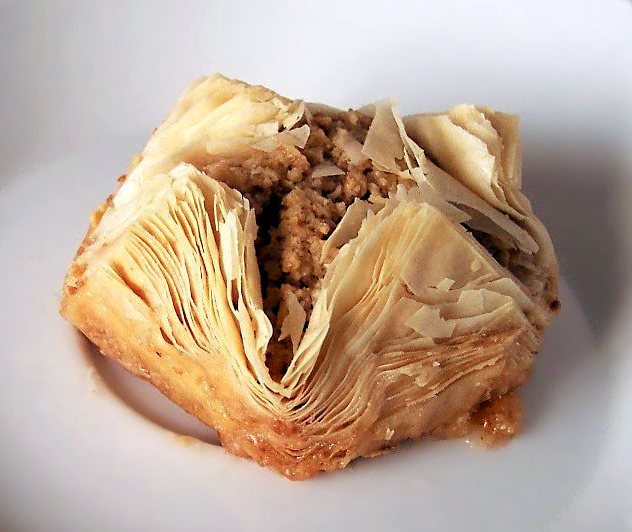
Phyllo, filo, or fillo dough is paper-thin sheets of unleavened flour dough used for making pastries in Middle Eastern and Balkan cuisine. Phyllo dough is made with flour, water, and a small amount of oil and rak? or white vinegar, though some dessert recipes also call for egg yolks. Phyllo can be used in many ways: layered, folded, rolled, or ruffled, with various fillings. [Wikipedia]

Succotash is a food dish consisting primarily of corn and lima beans or other shell beans. Other ingredients may be added including tomatoes and green or sweet red peppers. Because of the relatively inexpensive and more readily available ingredients, the dish was popular during the Great Depression in the United States. It was sometimes cooked in a casserole form, often with a light pie crust on top as in a traditional pot pie. Succotash is a traditional dish of many Thanksgiving celebrations in New England as well as in Pennsylvania and other states. In some parts of the American South, any mixture of vegetables prepared with lima beans and topped with lard or butter is called succotash. [Wikipedia]
Shared flavor compounds
These compounds appear in both Phyllo dough and Succotash, giving them a molecular basis for flavor affinity, the pairing principle articulated by Francois Benzi and implemented in flavor-pairing research.
Why it works
The flavor-pairing hypothesis proposes that ingredients sharing significant aromatic compounds harmonize on the palate. Phyllo dough and Succotash overlap on 17 key compound(s), which is why classic culinary traditions, and our deterministic matching algorithm, place them together.
- Pairing computed by: pairing-compute
- Methodology: deterministic compound-overlap matching (no LLM)
- Compound data: Wikidata + Wikidata
- Part of: Living Gastronomic Intelligence graph