Tapioca pearl + Phyllo dough

Tapioca is a starch extracted from Manihot esculenta. In India, the term 'Tapioca' is used to represent the root of the plant (Cassava), rather than the starch. In Vietnam, it is called bot nang. In Indonesia, it is called singkong. In the Philippines, it is called sago. Tapioca is a staple food in some regions and is used worldwide as a thickening agent, mainly in foods. In Britain, the word tapioca often refers to a milk pudding thickened with arrowroot, while in Asia the sap of the sago palm is often part of its preparation. Tapioca is gluten-free, and almost completely protein-free. [Wikipedia]
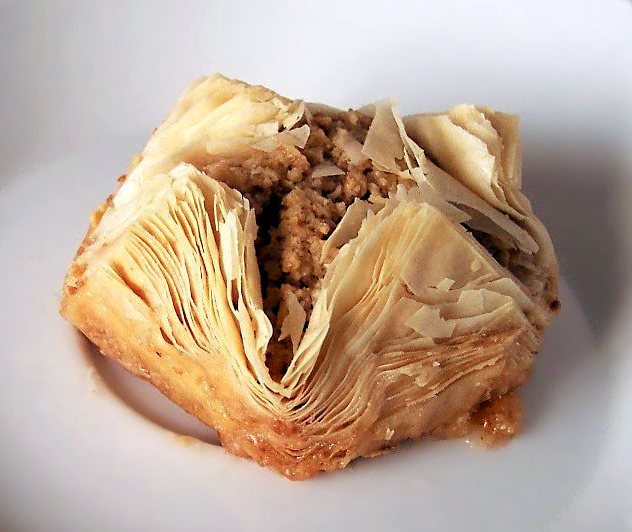
Phyllo, filo, or fillo dough is paper-thin sheets of unleavened flour dough used for making pastries in Middle Eastern and Balkan cuisine. Phyllo dough is made with flour, water, and a small amount of oil and rak? or white vinegar, though some dessert recipes also call for egg yolks. Phyllo can be used in many ways: layered, folded, rolled, or ruffled, with various fillings. [Wikipedia]
Shared flavor compounds
These compounds appear in both Tapioca pearl and Phyllo dough, giving them a molecular basis for flavor affinity, the pairing principle articulated by Francois Benzi and implemented in flavor-pairing research.
Why it works
The flavor-pairing hypothesis proposes that ingredients sharing significant aromatic compounds harmonize on the palate. Tapioca pearl and Phyllo dough overlap on 17 key compound(s), which is why classic culinary traditions, and our deterministic matching algorithm, place them together.
- Pairing computed by: pairing-compute
- Methodology: deterministic compound-overlap matching (no LLM)
- Compound data: Wikidata + Wikidata
- Part of: Living Gastronomic Intelligence graph